2021-08-25
For system design, people always try to use the most ideal solution to achieve the most efficient design.Compared with planar rectifiers, grooved Schottky rectifiers bring us one step closer to the ideal solution.
In order to pursue more efficient design, we will continue to optimize our electronic system. For many system-level circuits, especially power conversion circuits, planar Schottky barrier diodes have always been the traditional mainstream design solution, but planar Schottky diodes need to be weighed against key performance indicators such as forward voltage drop and leakage current. . Similarly, in electromagnetic sensitive applications, traditional Schottky barrier diodes are not ideal lossless and instantaneous rectification solutions.
The ideal rectifier should have low forward voltage drop, high reverse blocking voltage, zero leakage current and low parasitic capacitance. But to achieve this in practical applications, a trade-off must be made between these parameters.
For example, the use of certain metals can minimize the forward voltage drop at the metal-semiconductor interface, but at the expense of higher reverse leakage current. Or, if the drift region is widened to obtain a higher reverse blocking voltage, the advantage of the low forward voltage drop across the Schottky junction may be weakened or even disappear. This is why the reverse of the Schottky rectifier the blocking voltage is usually limited to 200V or less.
Therefore, increasing the reverse blocking voltage without increasing the reverse leakage current is a challenge faced by the current planar Schottky rectifier design. The limitation of the planar Schottky is that the equipotential barrier lines tend to gather near the metal electrode rather than the substrate. When the critical electric field is exceeded near the surface, it will cause early breakdown. By etching the trench into the silicon and filling it with conductive polysilicon, the drift electrons in the reverse drift zone can be effectively depleted, and the electric field in the drift zone can be evenly distributed.
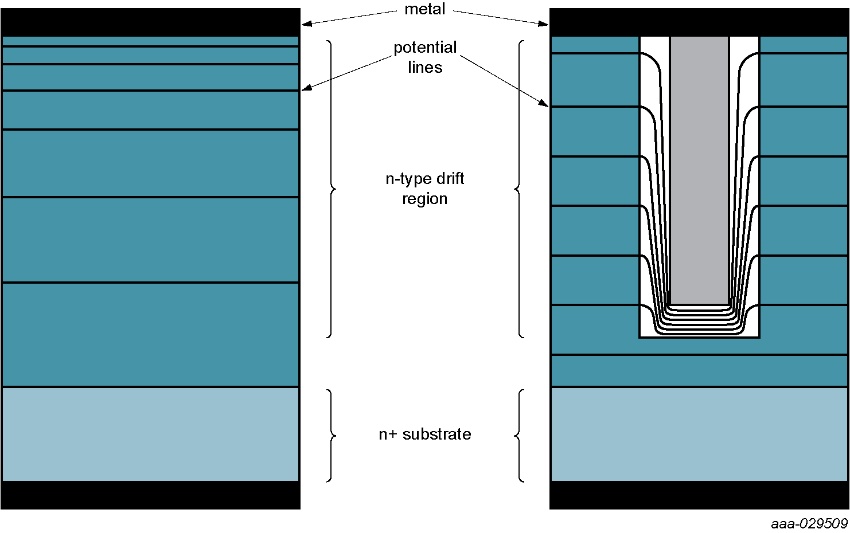
Equi-potential lines in a planar Schottky rectifier and in a Trench Schottky rectifier in reverse direction
This means that theTrench trench Schottky rectifierseries achieves a good balance between VF and IR. Compared with planar Schottky diodes, trench Schottky devices have a wider safe operating range (SOA). Due to their robustness to thermal runaway, this makes them ideal for applications with higher ambient temperatures.
Compared with planar Schottky diodes, the additional RC in the trench Schottky rectifier circuit provides another advantage. It provides better electromagnetic compatibility, so the trench rectifier is more suitable for electromagnetic sensitive applications.
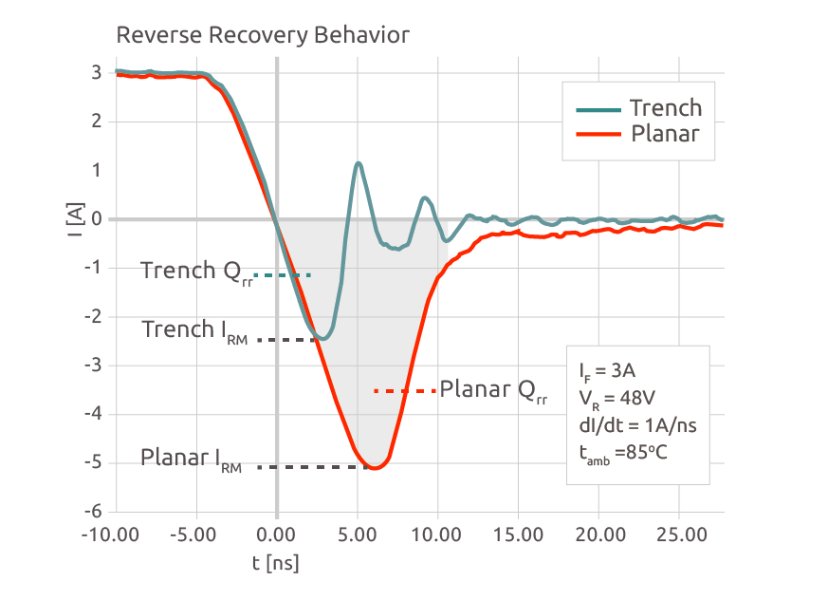
Comparison of reverse recovery behavior of a Trench Schottky diode to its planar counterpart
The Trench Schottky diode has much less Qrr compared to the planar Schottky. This results in lower switching losses when used in a switch-mode converter circuitry. EMI measurements revealed that the observed “ringing” of the Trench Schottky does not affect the electromagnetic emission levels.
By combining Schottky and Trench technology, the latest Trench Schottky rectifier brings many performance advantages. Trench Schottky diodes provide a better balance between forward voltage drop and leakage current. They also have excellent EMC performance and robustness to thermal runaway effects.
Designers need to pay attention only when considering parasitic capacitance-usually, the total parasitic capacitance of a trench Schottky rectifier per unit area is higher than that of a planar rectifier. Therefore, if a lower capacitance rectifier tube is required in system applications with higher switching losses, planar Schottky is a better choice. However, in applications where most losses are due to forward voltage drop or leakage current, trench rectifiers are undoubtedly a better choice.
Article Source:https://efficiencywins.nexperia.cn/efficient-products/Why-Trench-Schottky-rectifiers-are-the-preferred-choice.html.